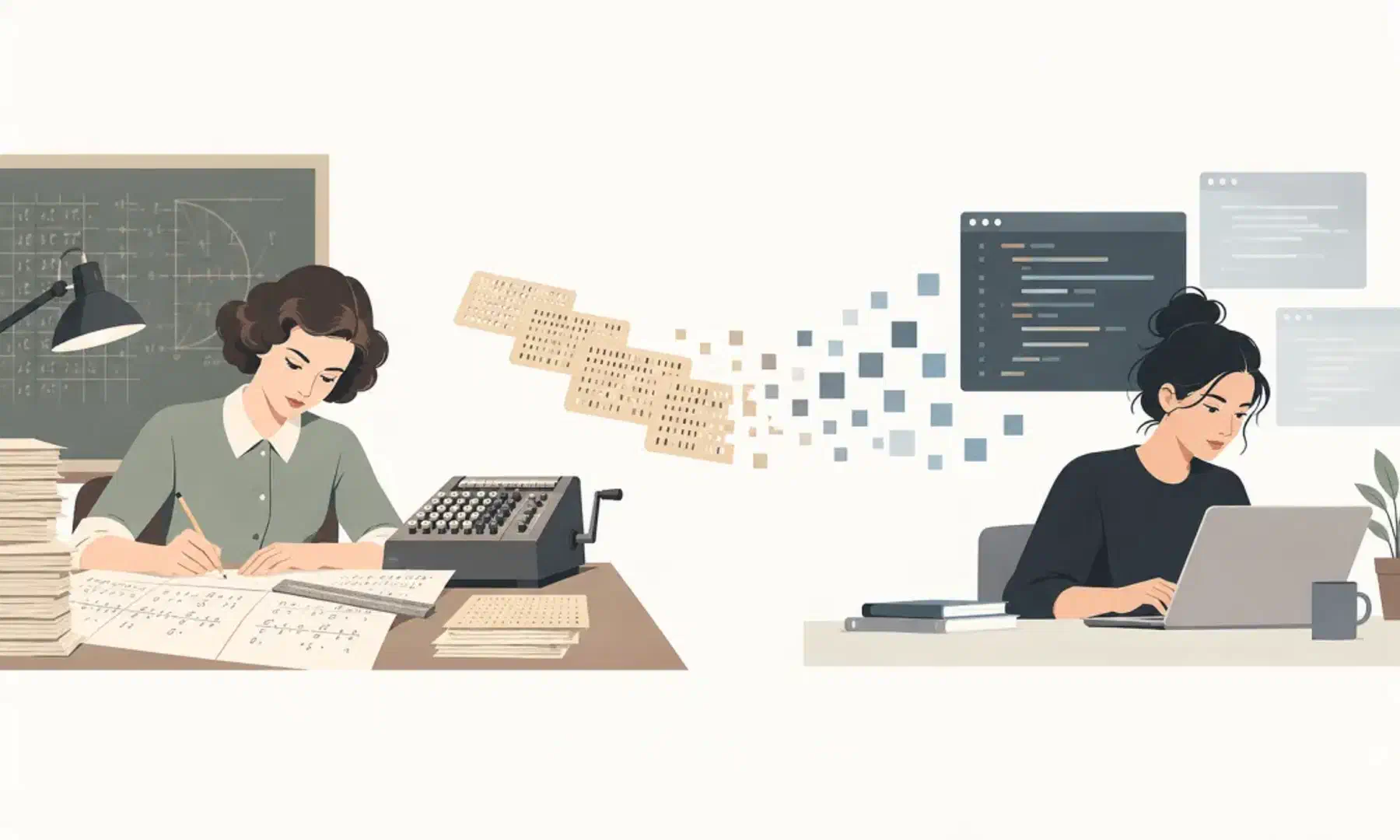
Is This Our Last Programmers' Day?

Today is October 24—celebrated in China as Programmers’ Day, since 1024 = 2¹⁰ is a neat, auspicious round number in binary. Given the occasion, I want to share a few thoughts on programming as a profession.
I have a strong hunch: this may be the last Programmers’ Day we ever celebrate.
October 24 will still roll around next year, of course. By “last,” I mean the end of the “programmer” as a standalone trade—one that may soon become a historical footnote, much like the original job called “computer.”
1. From Human Computers to a Historical Footnote
Today, “computer” means the machine on your desk. Decades ago, it was a job title: a human who computed for a living.
Human computers worked with paper, pencils, and slide rules, calculating exponents, logarithms, square roots, and calculus by hand. The film Hidden Figures tells their story: during the early-1960s space race, a team of Black women working as human computers at NASA’s Langley Research Center hand-verified the orbital trajectories for America’s first crewed spaceflight. At the time, computing was a respectable white-collar profession with a real barrier to entry.
We all know how that story ended. Electronic computers turned calculation from a human craft into a mechanical primitive. Outside of grade-school math drills, nobody makes a living extracting square roots by hand anymore.
The most telling arc in that film, though, belongs to Dorothy Vaughan. When she saw IBM mainframes being installed, she didn’t sit around waiting to be replaced. She taught herself FORTRAN, trained the women in her group, and led her entire team through the transition. The job of “human computer” vanished, but the computers who embraced the new machines first became the first generation of programmers.
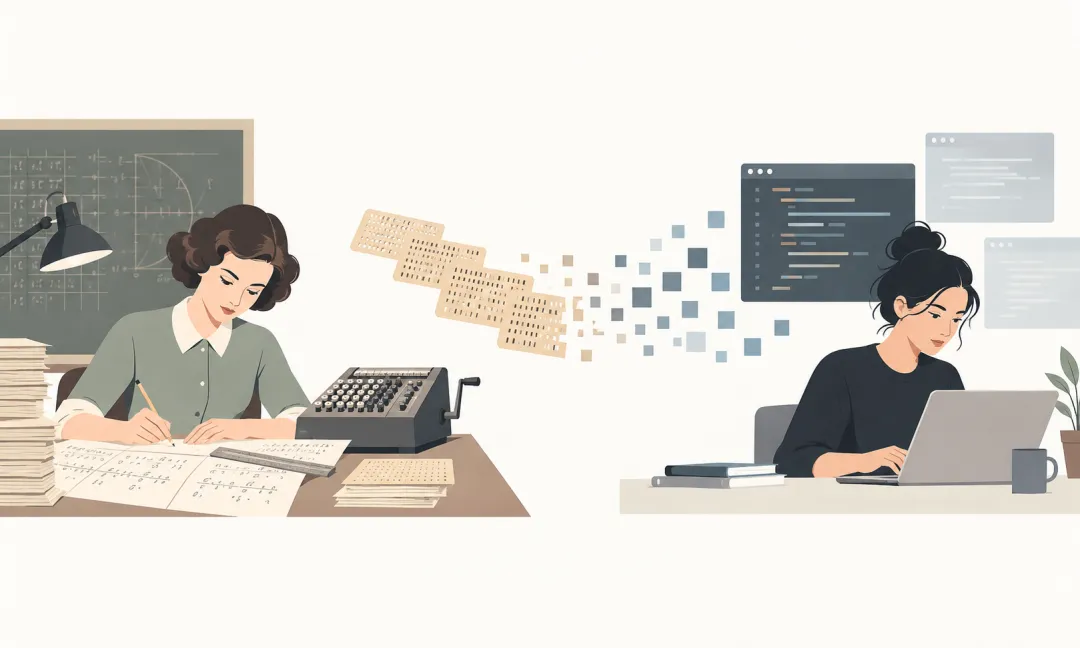
Today’s programmers stand where those human computers once stood.
As I argued recently in DeepSeek’s Interview with Bojie, hiring a new generation of AI-native engineers by making them grind out LeetCode-style algorithm puzzles from scratch is absurd. It makes about as much sense as testing early computer programmers on how fast they could do long division or extract square roots by hand.
Programming as a distinct occupation is coming to an end, and it is exiting the stage the exact same way human computers did when digital computers arrived.
2. Twilight of the Priesthood, Dawn of the Super-Individual
I understand why this upheaval has rattled so many peers. Just two or three years ago, programmers occupied a kind of priesthood. We commanded arcane incantations illegible to laypeople; with a few keystrokes, we could summon real power from cyberspace and collect enviable paychecks.
In barely two years, that monopoly has shattered. A technological Reformation has arrived: growing numbers of people who have never written code are picking up Claude Code and Codex like a vernacular Bible, bypassing the clergy to speak directly to the machine and build their own software.
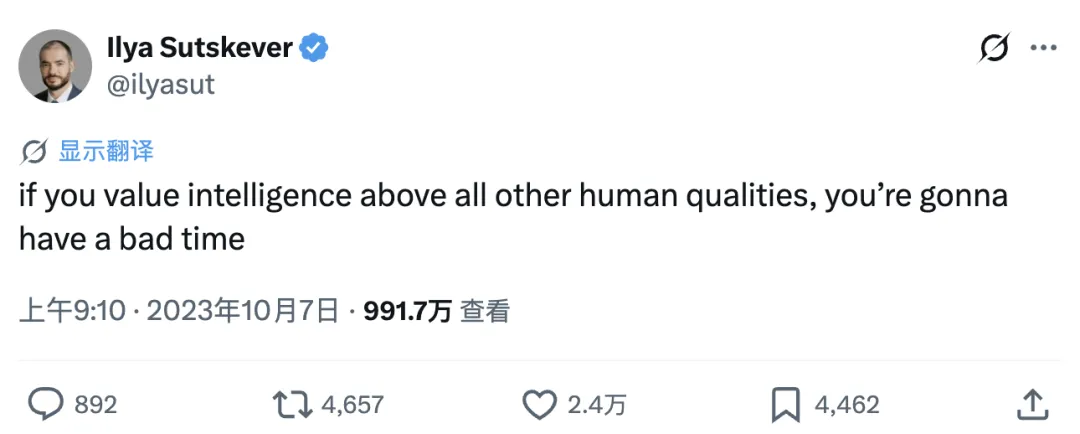
For traditional programmers, that is a blunt blow to both ego and livelihood. If your sense of superiority still rests on a test-prep mindset and hand-coding fluency, consider this sobering warning from AI pioneer Ilya Sutskever:
“if you value intelligence above all other human qualities, you’re gonna have a bad time”
— Ilya Sutskever
The flip side is that if you drop the ego and lean into this shift, you are not looking at doomsday—you are looking at an unprecedented era of compute leverage.
Cheap compute is a fulcrum that lets one person move engineering weight on a scale that used to be unthinkable. Projects that once demanded a dozen people and hundreds of thousands of dollars in seed capital can now be shipped solo on the back of a few $200-a-month frontier model subscriptions.
Meanwhile, as the cost of producing software plummets, demand doesn’t shrink—it expands. That is Jevons paradox at work. As every industry retools around automation, the appetite for software will dwarf anything we have seen before. The old moats have been filled in, but the frontier ahead is vast.
3. Programmers Will Disappear, Engineers Will Endure
If “programmer” becomes a historical footnote, what takes its place? The answer sits in an older, more fundamental title: programmers will disappear, but engineers will not.
In real software engineering, typing code was never the bulk of the job anyway. Fred Brooks’ classic The Mythical Man-Month laid out the time budget decades ago: 1/3 for design, 1/6 for coding, and 1/2 for testing.
That split still holds up. Outside a few specialized low-level domains, that middle 1/6 spent on coding is no longer the bottleneck. Once pocket calculators became ubiquitous, nobody competed on manual arithmetic speed anymore—what mattered was knowing which problem to set up and whether the result made sense.
That pushes the real bottleneck to the two ends: design and testing. Truth be told, today’s AI agents are already remarkably capable at both. Even so, humans must hold the line at the very beginning and the very end:
On the design end: supplying will and taste. At least today, AI does not generate its own purpose. It has no desires, feels no pain, and has no reason of its own to exist. It needs a human to define the goal, supply the spark, feed it tokens, pay the bill, and drive it forward through human will. And coming up with something genuinely worth building—deciding what to do and what not to do—comes down to taste.
On the testing and delivery end: supplying distribution and accountability. Purely agent-generated software carries zero credit on its own. For software to reach production and close a commercial loop, a real person or organization has to put skin in the game—backing the work with capital, reputation, and accountability.
Everything in between—the heavy lifting and plumbing—can now be handed off to agents, which do it faster and for a fraction of the cost.
Take this one step further: as the cost of building software drops, everything outside of pure engineering gains weight—distribution, marketing, and above all, building trust.
Anyone can knock out a flashy side project over a weekend now, and most of those repos are destined to rot untouched in a quiet corner of GitHub. The real test for modern engineers is getting other humans—or other agents—to actually use what you built, kicking off a feedback flywheel, and turning a codebase into a self-sustaining software business.
There is a half-joking line making the rounds lately: every startup today needs a CIO—not a Chief Information Officer, but a Chief Influencer Officer. Without real reach and earned trust, you cannot even turn the key on the machine.
4. Facing the Wave: It Is Not Too Late to Jump In
Is boycotting or refusing to use AI a viable option? Honestly, that road is a dead end. Both the US and China have laid their cards on the table: it is green lights and full throttle on frontier productivity—AI and robotics. The structural unemployment that comes with the transition gets reduced to a passing mention in the grand narrative, brushed off as inevitable growing pains, just as it was for handloom weavers in the Industrial Revolution, carriage drivers when the automobile arrived, and human computers when mainframes took over.
If your core skillset happens to sit squarely in AI’s blast radius, that is brutal—and it is through no fault of your own. Anger and anxiety are completely natural reactions, but they won’t change the math, and digging in your heels won’t improve your odds.
When a massive wave rolls in, the most dangerous place to stand is the shallows, where the surf crests highest and breaks hardest. You have two choices: retreat into deep water by mastering low-level domains AI still cannot touch, or paddle out and learn to surf the crest. Riding the crest isn’t safe either, but it gives you the clearest line of sight—and that is the only vantage point from which you can read the currents and spot the hazards ahead.
More importantly, it is nowhere near too late to get in the game.
Do not let the tech bubble fool you: real-world AI adoption in production is far shallower than social media makes it look. By my rough estimate, there are perhaps a million developers worldwide who are deeply fluent with AI, and maybe a hundred thousand operating as true “agent fleet commanders.” Set against 30 to 50 million developers globally—let alone 8 billion people—that is still a tiny fraction.
AI Adoption Isn’t as Deep as You Think
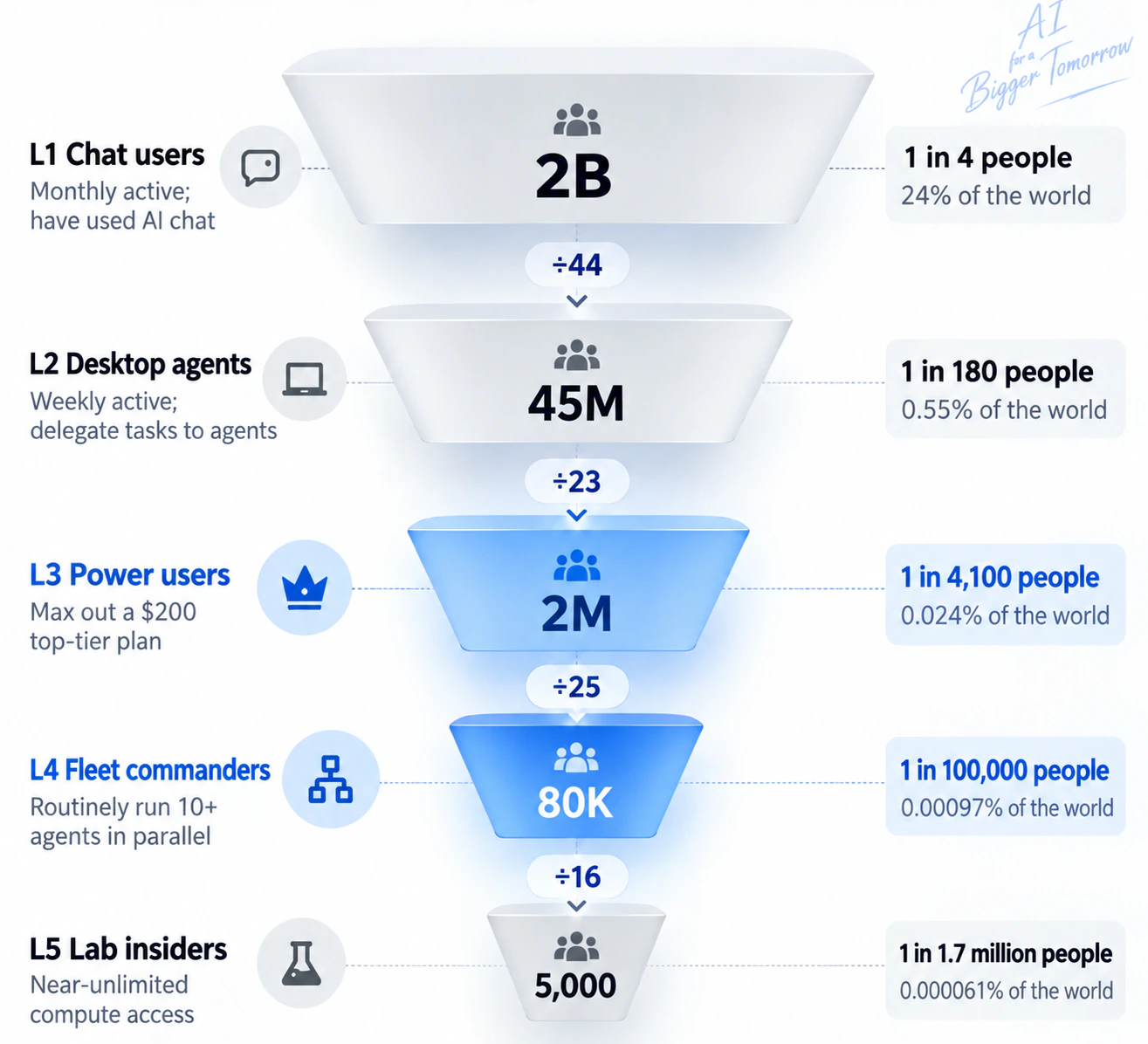
On this playing field, everyone started from scratch. Even the most battle-tested Claude Code power users on earth have less than two years under their belts. Those two years of hands-on intuition have already opened an order-of-magnitude productivity gap over traditional developers—but if you get your hands dirty now, that lead is still completely catchable.
Beyond that, getting a front-row seat to a historic technology going from zero to one—growing alongside it and feeling out each generational leap in the models firsthand—is a rare experience in its own right.
5. From Foot Soldier to Force Commander: Leading a Fleet of Agents
So how do you actually get started? The answer is simple: max out your compute and build your command instincts on real projects.
Spend twenty dollars a month on a chatbot to kill time, and at best you have a decent digital sounding board. Max out a $200-a-month frontier plan, however, and what you can ship solo will blow past what you used to think possible.
Several top-tier subscriptions add up to real money, of course, and you don’t need to buy them all on day one. Pick one flagship plan that fits your workflow, push it until you hit the rate limits, and only then decide whether to add another. Stack that bill up against the cost of hiring even a single engineer, and the math is obvious.
The core skill to develop along the way is a feel for each model’s temperament.
Do not treat Codex, Claude, Gemini, Grok, GLM, and DeepSeek as interchangeable tools. Treat them as digital colleagues with distinct personalities and strengths. Each has its own sweet spots, reasoning quirks, ways of cutting corners, and blind spots. Running workloads across a dozen top-tier subscriptions every day has made this very clear to me. Learning how to work with this roster—reading their tendencies and matching the right agent to the right job—is becoming a core discipline for every engineer.

You cannot pick up that intuition by reading 10 tutorials or sitting through 100 talks. The only way is to roll up your sleeves and run hard, real-world engineering workloads—hitting walls and learning where the edges are. That is how orchestration becomes second nature: knowing which job goes to which agent, how to decompose goals, how to delegate authority, where to draw boundaries, and how to review and sign off on the output.
Ultimately, every programmer has to make a shift in identity: from a foot soldier heads-down writing code to a commander running the operation.
In traditional engineering management, leading 8 people made you a team lead, a few dozen made you a middle manager, and a hundred or two made you a director. In the era ahead, a serious engineer starts out commanding a squad of 10 agents and scales up to a company of 100 or a battalion of 1,000. You will no longer prove yourself by how many lines of code you type by hand; the scale of the agent fleet you can effectively direct will define your new rank and reach.
Looking back, electronic computers did wipe out the profession of pencil-and-paper human computers, yet they also kicked off the golden age of software engineering—and among the very first programmers were former human computers like Dorothy Vaughan who turned to meet the new machines early.
Today, the rise of AI agents is ending the era of the hand-coding programmer while opening one where a single engineer can operate as an entire army. Yesterday’s human computers became the first programmers; today’s programmers can become the first fleet commanders.
Happy 1024 Programmers’ Day—perhaps our last. When you wake up tomorrow, welcome to the new world of engineers and commanders.